
- Referencia:
- 80492
- Editorial:
- CONSEJO SUPERIOR INVESTIGACIONES CIENTÍFICAS
- ISBN:
- 978-84-8052-122-2
- Alto:
- 220mm
- Ancho:
- 150mm
- Pàgines:
- 548
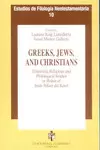
GREEKS, JEWS AND CHRISTIANS
HISTORICAL, RELIGIOUS AND PHILOLOGICAL STUDES IN HONOR OF JESÚS PELÁEZ DEL ROSAL
LAUTARO, ROIG / MUÑOZ, ISRAEL
The present festive volume in honor of my friend and colleague Prof. Jesús Peláez del Rosal includes twenty-two articles by colleagues, disciples, and friends intentionally covering his fields of expertise in the heterogeneous group of disciplines clustered under the collective title of Biblical Studies. The wide spectrum of subjects of these articles properly reflects Peláezs interests and activities during his academic career, both as Professor of Greek Philology at the University of Córdoba and as editor-in-chief of the Publishing House El Almendro. As is also the case for the journal Filología Neotestamentaria, la niña de sus ojos, founded by Peláez and published conjointly by the University of Córdoba and El Almendro, articles were accepted in five different languages, namely Spanish, English, German, French, and Italian.
The preparation of this volume has been arduous indeed. After announcing our intention to offer Professor Peláez a Festschrift on the occasion of his retirement, we received so many positive reactions that they surpassed the material limits of a volume. Moreover, due to Jesus' various fields of expertise, it was also a challenge to sort the materials in such a way that the homage would not result in too heterogeneous a volume. This is the reason why we decided to present the numerous articles (more than thirty!) in two separate books. The first of them, which, dear reader, you have now in your hands, includes studies and essays on Old and New Testament philology in its widest sense. The second volume, which will appear simultaneously, may be described as a liber amicorum and includes articles by his closest friends, collaborators, and colleagues from the University of Córdoba on a variety of subjects, from the semantics of New Testament Greek to a Hispano-Hebraic piyyutim.
As far as the present volume is concerned, it is organized in three sections. The first of them includes studies on the Old Testament, the second on the New Testament, and the third includes papers with a wider philological character. The Old Testament part includes four studies and opens with an article by Steven E. Runge, Where Three or More are Gathered there is Discontinuity: The Correlation between Formal Linguistic Markers of Segmentation and the Masoretic Petû?â and Setûmâ Markers in Genesis. The intention of the author is to shed some light on the chapter divisions within certain pericopes which did not include paragraph markers (petû?â and setûmâ). In certain cases, such as Gen 22,1-18 and 22,19-2, the Masoretic text subdivides sections into two pericopes; in other cases, such as Gen 18-19, pericopes have been divided into chapters where Biblia Hebraica Stuttgartensia does not insert petû?â and setûmâ accents. With a view to determining whether there are formal linguistic features which guided the Masoretic division of the text, Runge describes the formal linguistic segmentation markers found in the Biblia Hebraica at petû?â and setûmâ divisions. The article surveys the places where differences can be detected between Masoretic and traditional chapter divisions, and attempts to determine the exegetical ramifications of these differing traditions of pericope division.
The second chapter, by Florentino García Martínez, La geografía como teología: del Libro de los Jubileos al Phaleg de Arias Montano, offers a comparative analysis of various writings including an interpretation of Genesis Chapter 10. The author first analyzes the oldest interpretations as found in the The Book of Jubilees and in the Genesis Apocryphon, an Aramaic composition found in Cave 1 at Qumran. The theological agenda of both writings composed in the second century B.C.E. is then compared with later interpretations of the same chapter of Genesis, namely the one offered by Flavius Josephus in his Jewish Antiquities, the Aramaic translation of the Targum Neofiti 1, and the one contained in the geographical treatise Phaleg by Arias Montano. The comparison reveals important differences in the appropriation of Genesis Chapter 10: While the earlier texts transform the biblical text for theological reasons, later ones are mainly intent on actualizing the ethnographical and geographical data found in Genesis by means of the new geographical knowledge of their own periods.
In La luce, metafora sapienziale nellAT, Horacio Simian-Yofre surveys the metaphor of light in the Old Testament and provides an overview of its various meanings. The paper is divided into six main sections, of which the first three focus on conceptual issues: light as a representation of the divine presence and its attributes, the relationship between the metaphor of light and notions such as truth or the good, and the close connection between truth and faithfulness/loyalty. The fourth and fifth sections in turn explore the difficulties faced by the authors of the Book of Job and Qohelet in their attempt to attain light and wisdom, concepts which in their views are closely connected. The paper ends with a short comment on the rejection of light and the attraction of darkness.
The philological note by G. Thomas Hobson, Karath as Punitive Expulsion, brings to a close the section on the Old Testament. It provides an analysis of the non-literal extended meanings of the Hebrew term karath, extermination, expulsion. It argues the plausibility that the Torah penalty, cut off from his people, most often denotes expulsion from the Israelite community.
The section on the New Testament occupies the central part of the volume and includes thirteen studies. It opens with a study by David Alan Black and Thomas W. Hudgins, Jesus on Anger (Matt 5,22a): A History of Recent Scholarship. The authors approach a much debated issue in New Testament studies, namely whether the word e??? in the text of Matt 5,22a is original or not. Back in 1988, Black argued for its originality in an article published in Novum Testamentum. In the present paper the authors explore the scholarly discussion on this variant over the last 25 years.
The study by Fernando Camacho Acosta, El relato de la curación del paralítico en Marcos (2,1-12), has a more theological dimension, since it shows how the healing of the paralytic in Mk 2,1-12 is used to present Jesus as someone who has received the authority to forgive sins on earth directly from God. According to the author the whole section is a programmatic narrative presenting Jesus as a healer of both mental and physical human diseases. Interestingly, the story claims the oneness between God and Jesus is due to the fact that the latter receives the power to forgive sins, something that was blasphemy for Jewish orthodoxy, since that capacity was only attributed to God.
Paul Danoves Mark 1,1-15 as Introduction to Characterization, in its turn, introduces a more literary philological approach to the New Testament, since it applies semantic, thematic, structural, narrative, and rh